The Lemon Cipher
At a clandestine diplomatic summit hosted in a remote country manor, a classified document is missing. The investigation requires reconstructing the last 48 hours through physical traces and testimonial friction to identify the responsible party, while navigating the social minefield of powerful officials protecting their own reputations.
 Initial Crime Scene
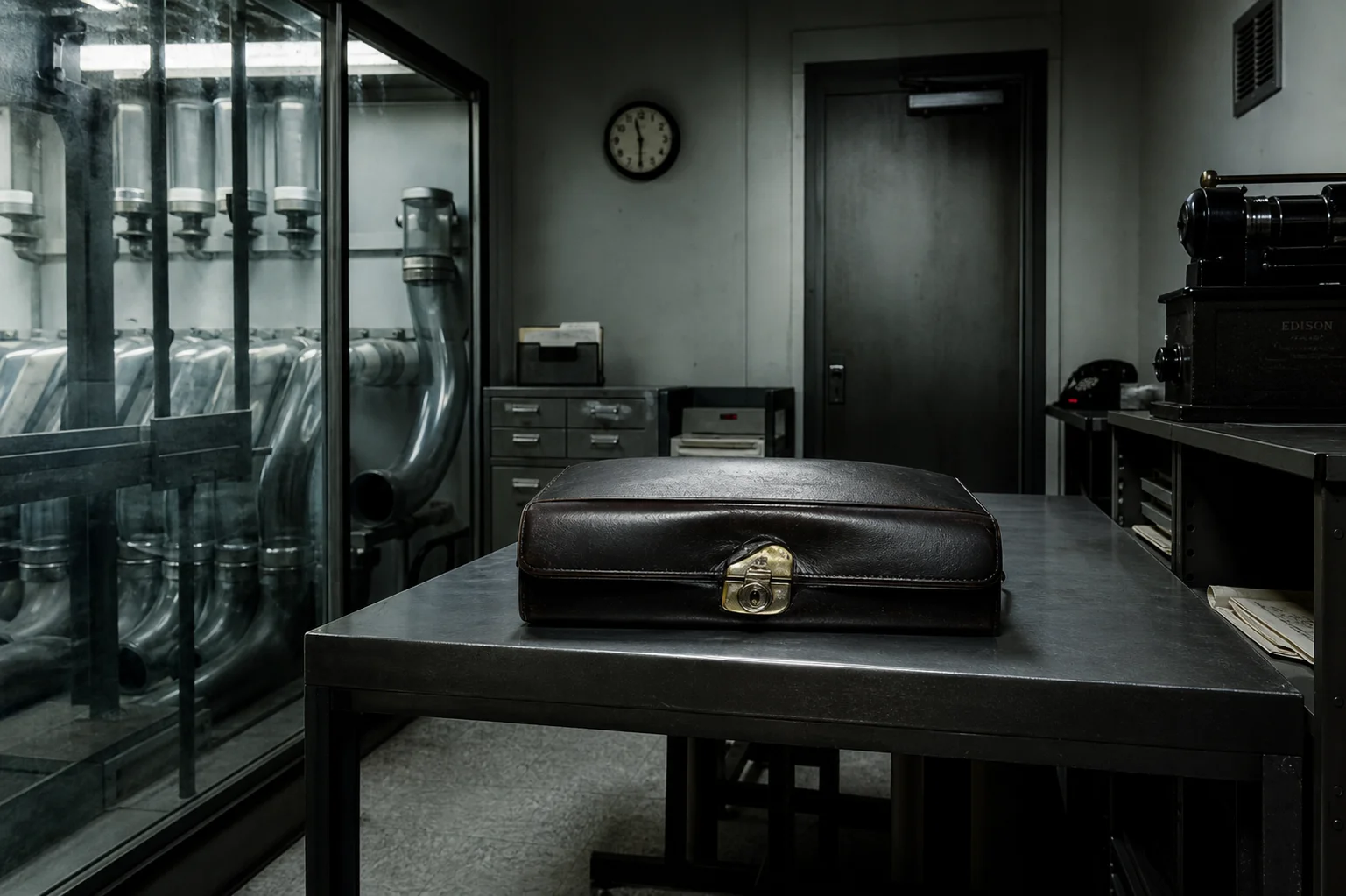
The damp air of the pneumatic tube dispatch room smells of ozone and developer fluid. Fingerprint powder residue coats the glass surfaces. The hum of a transformer underlies the silence. Your gaze falls on a government-issue leather briefcase lying on a steel table, its brass clasp bearing prominent deformities. A wax cylinder dictaphone sits on a nearby shelf, its grooves catching the light.
 Crime Scene Environment
The environment is defined by clinical, sterile fluorescence in enclosed spaces, creating sharp shadows and a cool, damp micro-climate. The acoustic density is low, dominated by mechanical hums—the constant thrum of a transformer, the click of a relay, the whir of a tape reel—and the hollow, monotonous echoes of footsteps on linoleum or stone. Humidity is high, causing surfaces to feel cold to the touch.
 Investigation Constraints
Pre-digital era espionage: mechanical cipher machines (e.g., Enigma variants), pneumatic tube message systems, dictaphones with wax cylinders, rotary dial telephones with party lines, microdot photography, fingerprint powder and brushes, chemical reagents (ferric chloride for ink development), secure document burn bags, and manual keycard locks on briefcases and filing cabinets.
✦ Related Cases ✦