The Mercury Protocol
An independent forensic specialist is dispatched to the British Embassy in Bonn to investigate a critical malfunction in the 'Mercury' diplomatic cipher machine. The inquiry involves six embassy personnel, whose professional duties intersect with the compromised communications security. The investigation focuses on physical traces, operational logs, and personnel movements to determine the sequence of events leading to the machine's failure.
 Initial Crime Scene
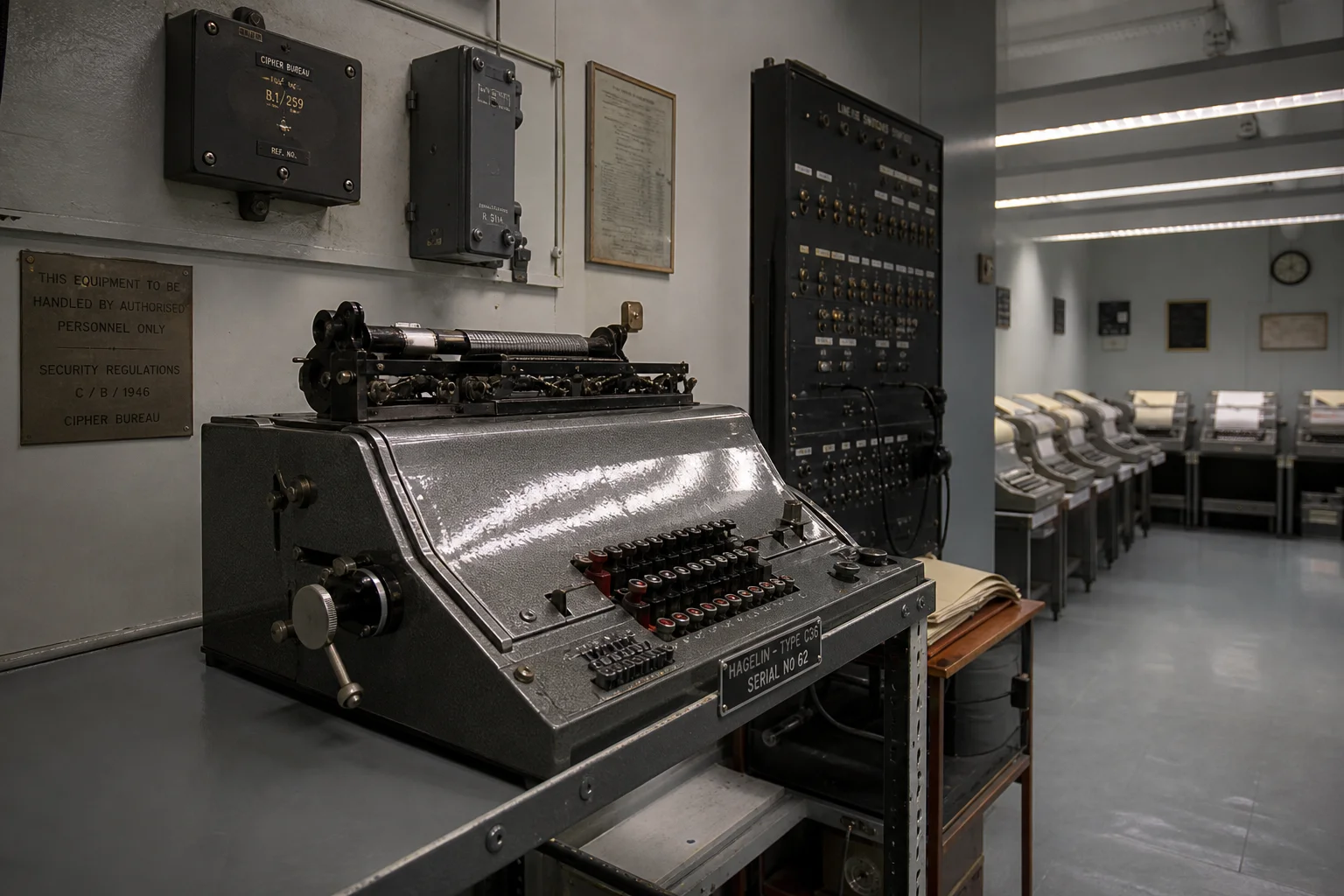
The fluorescent light hums, casting a sterile glow on the polished grey linoleum floor. The air carries the faint, sharp scent of ozone from inactive vacuum tubes. A heavy steel cipher machine dominates the reinforced shelf, its housing reflecting distorted light. Banks of silent teletype machines line the opposite wall, and a manual switchboard panel sits dark and dormant.
 Crime Scene Environment
Lighting is artificial and constant from overhead fluorescent tubes. The air is climate-controlled, with low humidity and a cool, stable temperature. Acoustic density is defined by the low, pervasive electric thrum of dormant machinery, creating a baseline of static silence.
 Investigation Constraints
Cold War-era electromechanical cipher machines (e.g., Enigma-type rotors), manual punch card systems, pneumatic tube message delivery, analog surveillance microphones and wiretaps, paper logbooks with carbon copies, mechanical typewriters, teletype machines, manual telephone switchboards, forensic photography with chemical development.
✦ Related Cases ✦