The Strain on the Crane
An independent investigator is summoned to the industrial waterfront of Pier 14 following the discovery of a dock foreman's body. The inquiry uncovers a dense network of falsified records, conflicting alibis, and peripheral misconduct among dock officials, a union steward, a private security consultant, and a society wife, each harboring their own clandestine pressures.
 Initial Crime Scene
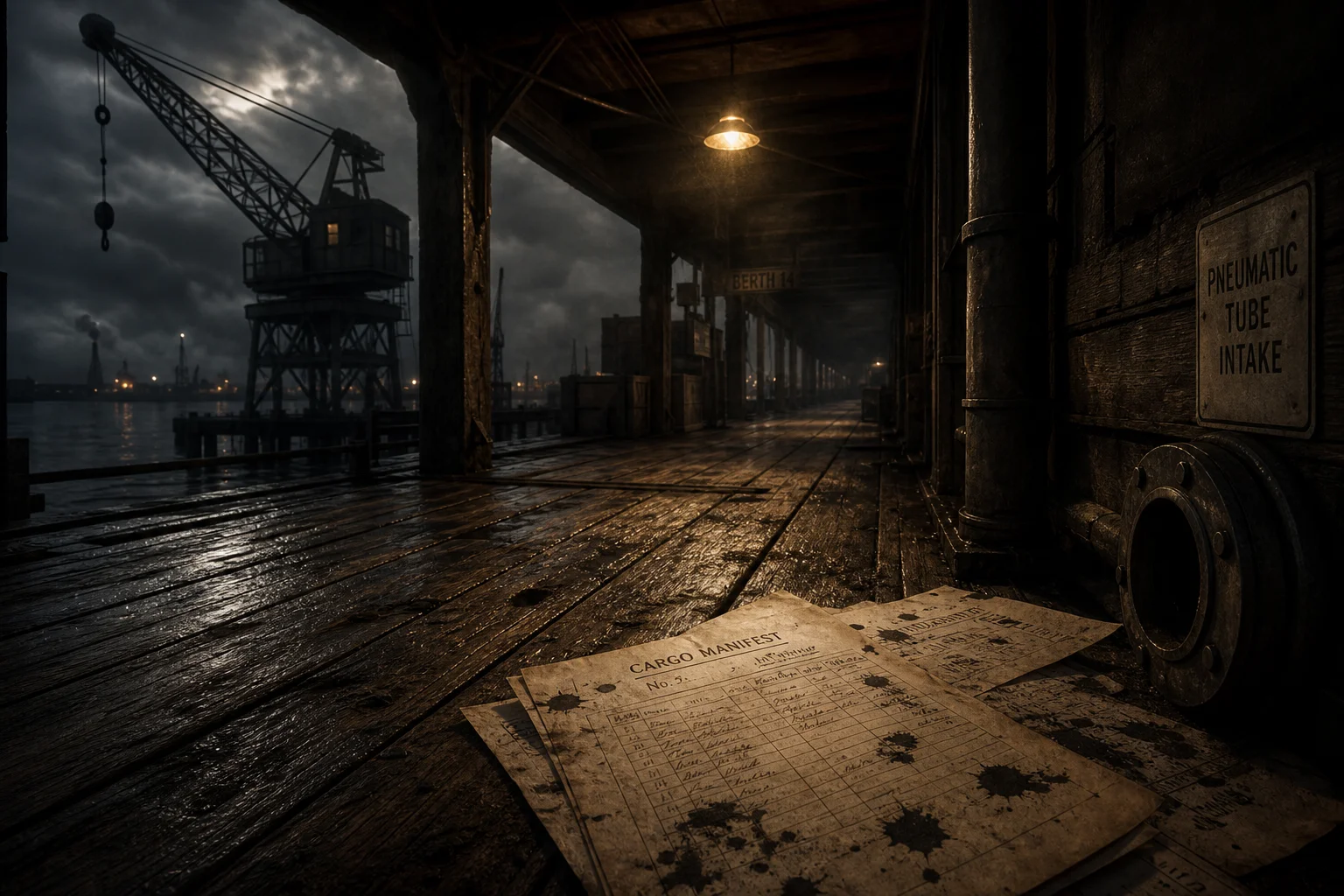
The heavy, metallic scent of brine and diesel hits first. Under the low, amber glow of a single industrial lamp, the long wooden pier stretches into the gloom, its planks scarred by a deep, linear gouge. To the left, the skeletal arm of a mechanical cargo crane hangs motionless against the churning harbor sky. Ahead, ink-stained cargo manifests lie scattered near a pneumatic tube intake, their carbon-copy duplicates smeared with dark blotches.
 Crime Scene Environment
The sandbox operates under a permanent, low-watt amber lighting profile that casts long, shifting shadows. The air is saturated with humidity, carrying a persistent chill from the harbor and a fine grit that settles on all surfaces. Acoustic density is high: the intermittent, rhythmic clatter of distant machinery, the low hum of electrical transformers, and the ever-present, churning sound of water against the pier supports define the environment.
 Investigation Constraints
Analog telephones, physical pneumatic tube message systems, punch-card tabulating machines for cargo manifests, electric teletype machines for inter-office communication, mechanical cargo cranes, paper-based accounting ledgers, film-based security cameras (limited to high-security warehouses), and manual fingerprint dusting kits.
✦ Related Cases ✦