The Tide of Reckoning
At the dawn of a critical estate valuation, the discovery of Lord Harrington in his study—found near a displaced globe stand and an askew morning tea tray—plunges the household into a maelstrom of buried grievances. As the heir, the staff, and the family solicitor scramble to protect their futures, their conflicting accounts and panicked adjustments weave an impenetrable web around the simple, fatal truth.
 Initial Crime Scene
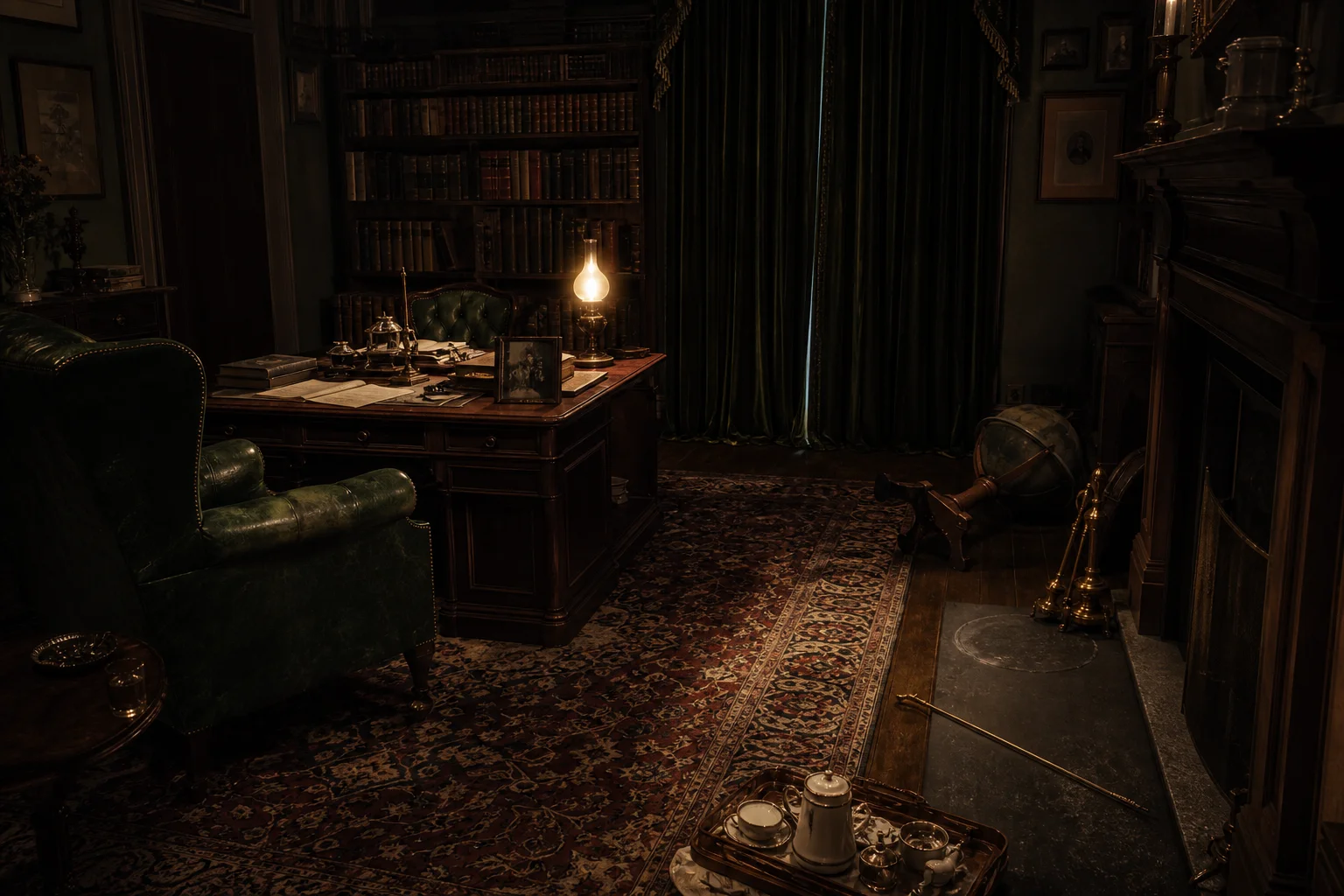
The scent of old paper, beeswax polish, and cold pipe tobacco hangs heavy in the still air. Your footstep echoes once on the threshold before being swallowed by the deep pile of a Persian rug. The room is a study of mahogany and green leather, long shadows cast by a single gas lamp on the desk. A deep, circular impression mars the polished hearthstone. A brass poker rests nearby, its tip faintly smudged. The velvet curtains are drawn tight against the night.
 Crime Scene Environment
Lighting is a singular, unwavering gas bracket that casts sharp, defined shadows. The air carries a persistent chill, a low humidity that holds the scents of the room without dispersion. Acoustic density is high; sounds are dampened and absorbed by the deep-pile rug, heavy curtains, and book-lined walls, creating a pressurized silence.
 Investigation Constraints
Edwardian-era estate. Communication is by handwritten note, delivered by servants, or the single household telephone in the hall. Security relies on physical locks (keys), watchmen's rounds, and the inherent social order. Record-keeping is in leather-bound ledgers, personal diaries, and the household accounts book.
✦ Related Cases ✦