The Ledger's Last Page
In the 1920s jazz world, the death of a bandleader exposes a network of falsified records, compromised reputations, and a missing contract that binds the city's brightest stars. The investigation centers on a forced lockbox, compelling the circle to confront the fabricated foundations of their careers.
 Initial Crime Scene
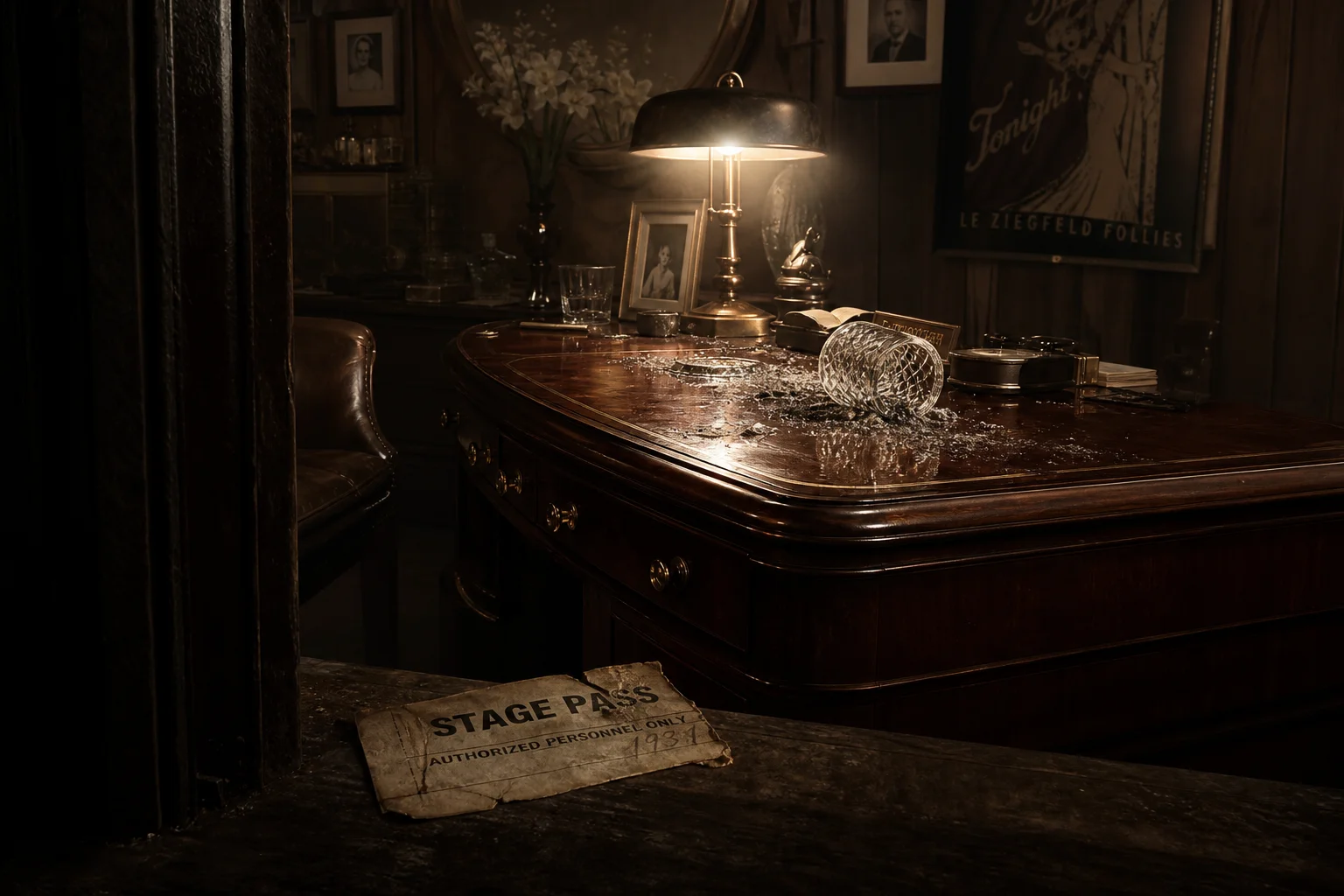
The scent of cheap, mass-produced perfume clashes with expensive, custom fragrances in the thick air. A faded backstage pass with torn perforations lies near the threshold. The crystal facets of an overturned ashtray catch the lamplight, scattering ash—fine, pale grey and coarser, darker—across the polished mahogany of a desk.
 Crime Scene Environment
The space is defined by a jaded, glittering veneer over volatile, veneer-thin realities. Lighting is low and theatrical, throwing sharp shadows from a single desk lamp. The humidity is low, the air dry and still, carrying the acrid tang of stale smoke and spilled champagne. Acoustic density is heavy; the silence is punctuated only by the faint hum of pneumatic tubes and the distant, muffled sounds of the building.
 Investigation Constraints
Prohibition-era (1920s-1930s) communication and security: rotary telephones, telegrams, pneumatic tube systems, handwritten letters, mechanical combination locks, steel filing cabinets, glass-plate photography, simple alarm bells, and vaudeville stage machinery. No digital technology exists.
✦ Related Cases ✦